
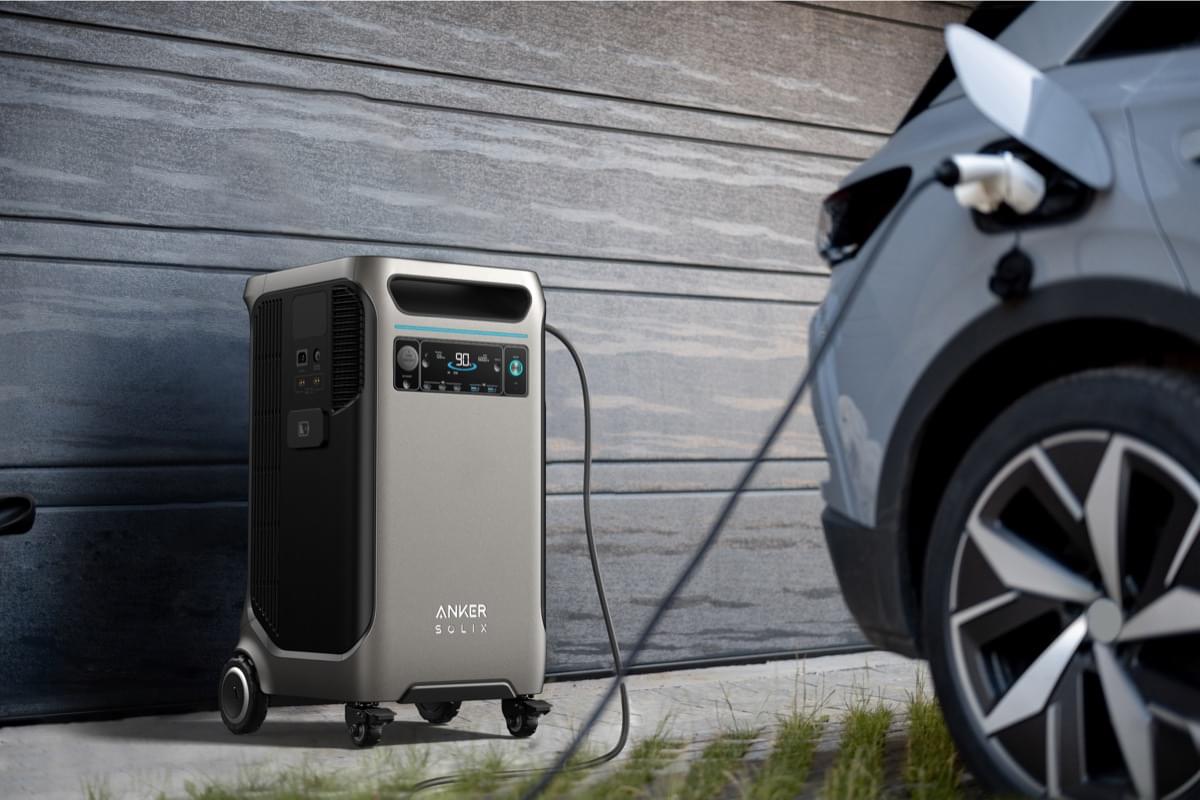
Imagine this: a power outage hits, and your electric vehicle (EV) is running on empty. It's a modern-day nightmare for any EV owner. But what if you had a portable powerhouse that could get you back on the road? At TeqClub, we're diving deep into the Anker SOLIX F3800 to answer a critical question: is it a practical EV charger or just a gimmick? This comprehensive guide will give you a data-backed verdict, moving beyond marketing claims to show you exactly what to expect.
1. The Powerhouse Specs: What Makes EV Charging Possible?
The Anker SOLIX F3800 isn't your average power station; it's engineered with EV charging in mind. The magic lies in three key specifications. First, its massive 6,000W continuous AC output provides enough power to charge demanding appliances, including an EV. Second, it delivers true 240V split-phase power, which is the same voltage used by most dedicated home EV chargers. This is a crucial feature that many portable power stations lack.
Finally, and most importantly, it includes a built-in NEMA 14-50 port. 🔌 If you're an EV owner, that plug should look familiar—it's the standard for many Level 2 home chargers and is commonly found at RV parks. This means you can often plug your existing mobile charger directly into the F3800 without any special adapters, making the process seamless. The unit's base capacity is a robust 3.84kWh, and it's expandable for even more energy storage.
2. Real-World Performance: Range per Hour Explained
Let's get to the numbers. How many miles of range can the Anker SOLIX F3800 realistically add to your car per hour? Its 6,000W (or 6kW) output is the determining factor. The actual mileage depends on your vehicle's efficiency, but we can calculate reliable estimates for popular models.
We've broken it down in the table below. This shows how the F3800’s 6kW output translates into tangible driving range for a solid hour of charging.
| EV Model | Approx. Efficiency (miles per kWh) | Miles of Range Added per Hour (at 6kW) |
|---|---|---|
| Tesla Model 3 (RWD) | ~4.0 miles/kWh | ~24 miles (~39 km) |
| Ford Mustang Mach-E (RWD) | ~3.4 miles/kWh | ~20 miles (~32 km) |
| Hyundai IONIQ 5 (RWD) | ~3.9 miles/kWh | ~23 miles (~37 km) |
3. How Much Total Range Can a Full F3800 Provide?
While the charging speed is impressive, the total range you can add is limited by the power station's battery capacity. The base Anker SOLIX F3800 holds 3.84kWh of energy. So, if you discharge the entire unit into your car, what does that get you?
- For a Tesla Model 3, you'd gain approximately 15 miles (~24 km) of emergency range.
- For a Ford Mustang Mach-E, it would provide about 13 miles (~21 km) of range.
This is designed to get you out of a tough spot—enough to reach the next public charger or get home during a blackout. For more range, the F3800's ecosystem allows you to connect expansion batteries, significantly increasing its total capacity and the emergency range you can add to your EV. 🚗
4. F3800 vs. Standard Home Chargers: A Head-to-Head Comparison
To put the F3800's performance into perspective, it's helpful to compare it to the standard charging methods EV owners use every day. As you can see, the F3800 carves out a powerful niche for itself.
| Charger Type | Power Output | Approx. Miles of Range Added per Hour |
|---|---|---|
| Level 1 Charger (Standard 120V Outlet) | ~1.4 kW | 3 - 5 miles |
| Anker SOLIX F3800 | Up to 6.0 kW | ~20 - 25 miles |
| Level 2 Charger (Common Home Install) | ~7.7 kW to 11.5 kW | ~30 - 45 miles |
The verdict is clear: the F3800 dramatically outperforms a standard wall outlet (Level 1) and operates in the same league as a lower-powered Level 2 home charger. This is a remarkable achievement for a portable solution.
5. The Verdict: Is the Anker F3800 a Practical EV Charger?
After analyzing the data, we can confidently say the Anker SOLIX F3800 is far from a gimmick. It is a highly practical and powerful emergency EV charging solution. Its 6,000W, 240V output via a standard NEMA 14-50 port makes it a legitimate tool for any EV owner concerned with power security.
However, it's not a replacement for a dedicated, grid-tied Level 2 charger for daily use. Its strength lies in specific scenarios:
- Power Outages: A lifeline to ensure you're never stranded.
- Off-Grid Living: Paired with solar panels, it can serve as a primary charger in remote locations.
- Worksite/Campsite Power: Provides charging capabilities where none existed before.
Your EV's Ultimate Backup Plan
The Anker SOLIX F3800 bridges the gap between portable power and serious EV charging. It provides meaningful range at a respectable speed, offering peace of mind and energy independence. For the EV owner who values preparedness, works in remote locations, or simply wants the ultimate home power backup system, the F3800 is an invaluable asset that delivers real-world performance.
Ready to equip yourself with the ultimate power security for your home and vehicle? Explore the impressive capabilities of the Anker SOLIX F3800 at TeqClub today. Have any questions? Drop them in the comments below or share this post with a fellow EV enthusiast!